- Published on
Local Maximums
- Authors

- Name
- Arnav Chauhan
- @arnvcn
Preface
About 4 months ago, I took a massive risk: With one final semester of high school left, I decided the smartest thing I could possibly do was finish school online and move to San Francisco. After spending my last summer in SF, surrounded by some of the smartest and most driven people I’ve ever seen, I just could not bring myself to wake up at 7AM every day and sit in 4 periods for 84 minutes each.
Since February, I’ve been working full-time at Vitalize (and finishing homework on weekends, but I digress) and the amount I’ve learnt in such a short span is extraordinary. There’s something new to learn and work on every day and being surrounded by brilliant people definitely doesn’t hurt. The city of San Francisco is also great; it’s geographically only about 7x7 square miles, but the amount of world-class talent you’ll run into at coffee shops and restaurants still blows my mind.
If they are reading this: A massive thank-you to Dr. Taylor, Dr. Decker, Mrs. Telfair, Mr. Jones, Mr. Black, and Mr. Hampton for accommodating everything and enabling me to chase these opportunities.
The following is the case I’d like to make on taking risks and why I think doing things outside of your comfort zone is the most efficient way to level up.
Please let me know if you have thoughts on this or have something to say. My email is in the footer of this website and I’d love to listen to you.
Timing
Magellan left Spain with five ships and a dream in 1519. California had the Gold Rush, whose settlers, coming in with hopes, dreams, and the clothes on their back, turned it into an economic powerhouse in 1848. 50 years ago in 1976, two guys in a Cupertino garage made Apple’s first computer, the ancient ancestor of what I’m writing this on right now.
The reason the world is the way we see it today is because one person decided not to be passive and jumped into the deep end, creating something that inspired another 4 people to jump into the deep end, who in turn inspired another 16 people to do the same. This chain reaction is what we call innovation, aptly put by Isaac Newton when he said that we are “standing on the shoulders of giants.”
I think we are insanely lucky to be in a time where the majority of our questions can be answered (not always correctly, but close enough) with a $20 subscription on our phones and laptops: ChatGPT/Claude/[insert AI model of choice here]. Physics concept doesn’t make sense? Gemini can make you an interactive simulation in seconds. Came across a historical text that you’re curious about? ChatGPT will send agents around the Internet to create an entire research paper about the origin and implications of that text in minutes.
We’ve democratized access to information so much that the barriers to create something generational are lower than they have ever been*. You no longer need a massive engineering team to build a prototype of a product or to graduate high school before you can experiment with new technologies. You can jump in the deep end today with zero context and build the plane while you’re flying it. It’s a great time to be alive.
*It’s also easier than ever for your thinking skills to atrophy, so tread carefully.
Calculus
I’d like to go back to one of the first few days of calculus and explain a few of the basic concepts again. Mrs. Bolden, if you are reading this, thanks for being a great calculus teacher and I’m sorry that I didn’t show up to class more often :)
I will preface this with a few points:
- There is rarely a time where you have truly hit any one of those points, but you can tell when you’re closer to one rather than the other three.
- “Success” here has a different and arbitrary definition for each individual; everyone has different priorities. It could mean the most money, most friends, most opportunities to learn, most 3 Michelin star restaurants, etc.
- Perspective matters: Your minimum could very well be the maximum for someone else and it’s important to keep that in mind. The world can be a harsh place, so be grateful for what you have.
For the following, the calculus definition states:
Local Minimum: A point where the function’s value is lower than the values nearby.
Local Maximum: A point where the function’s value is higher than the values nearby.
Global Minimum: The lowest value of the function on the entire domain.
Global Maximum: The highest value of the function on the entire domain.
That being said, the most ideal state is to be at the global maximum (top-tier talent, opportunities, food, etc.) and the least ideal state is to be at the global minimum (exhausted all resources, they didn’t exist in the first place, etc.)
The local minimum is all the places where you cannot foresee your individual situation becoming worse at a macro level (if it actually cannot get worse, you’re at the global minimum). The basics to survive are taken care of, but you probably aren’t feeling great about where you are at. It could be a horrible week at school/work, a ton of losses coming back-to-back, overall unhappiness with your situation, etc. I think that inherently, this is not a bad thing; you can survive and the only way to go is up.
The global minimum is, objectively, the worst position to be in. You’re fighting for survival, trying to make sure that you can eat the next day or have a place to sleep for the night. If you’re at the global minimum, you have bigger problems to deal with than what everything I’m talking about covers. I hope you find solutions to all your problems soon.
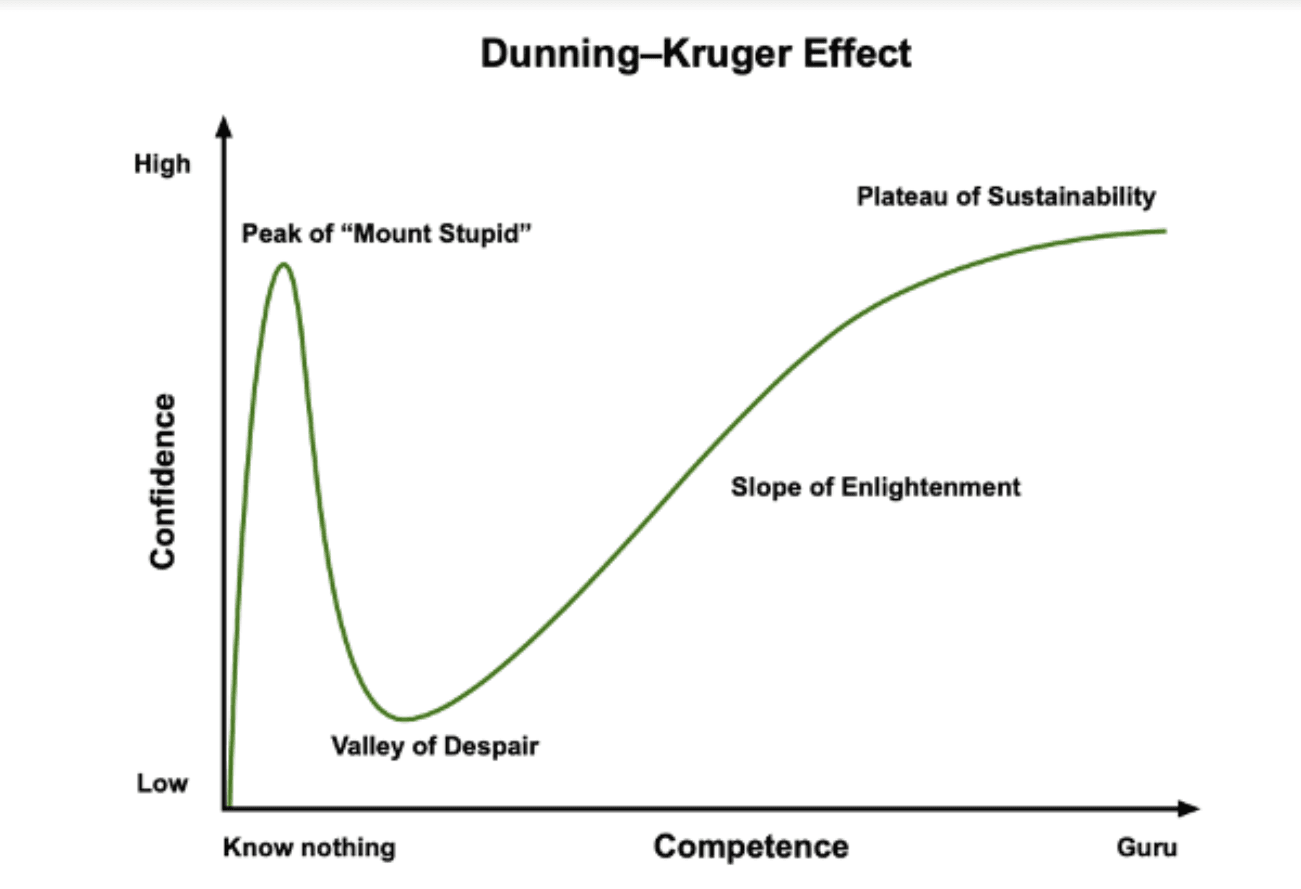
The most dangerous place to get trapped in is the local maximum. At a local maximum, you are used to feeling safe and comfortable. This is because there are no challenges activating your survival skills and invoking growth opportunities that force you to learn and upskill. You get to hide under a facade that makes you feel as if you’re in the top percentile for whatever field you’re in. For students, this means not feeling challenged by the schoolwork, getting comfortable, and forgetting how to learn properly. For employees, this means getting stuck doing monotonous work that doesn’t challenge you or working with people that don’t inspire you. The “Peak of ‘Mount Stupid’” in the Dunning-Kreuger effect will show up here.
The most transformative, and scariest to start, place to be is the global maximum.* You are surrounded by world-class talent, opportunities, and facilities, eating dinners at the same restaurants that the industry leaders are catching up at and running on the same trails that professional athletes are on in the mornings. The scary part is the imposter syndrome: when you’re surrounded by people that are at the highest tier of whatever field they chose to devote themselves to, what could you possibly be doing there?
The good part is that they quite literally could not care less about what you’re doing there; they have better things to do. In fact, many will go out of their way to help you because they remember what it feels like to show up with nothing (figuratively speaking) and would like to give back, the same way they were given advice, encouragement, or capital when they started.
All this being said, just being in proximity isn’t enough. The onus is still on you to build at a higher level than you ever have before, but it’s a lot easier when surrounded by people who achieved what you thought was impossible.
*Of course, these places are not automatically the best environment for every person, but they are unusually dense with talent, ambition, and opportunity.
Where can you find the global maximums?
I’ll take 3 industries and 3 cities to explain:
The global maximum of finance is in New York.
The global maximum of entertainment is Los Angeles.
The global maximum of technology is Silicon Valley.
These are epicenters of their respective industry. For whatever combination of factors that existed when they started, something drew the best of the best in that field to make their way to that epicenter.
New York had the original trade routes to Europe.
Silicon Valley had nice weather, tons of defense funding, and Stanford (Paul Graham has a fun essay on this topic).
Los Angeles has sunny weather, diverse landscapes, and tons of space.
Naturally, the best of the best want to work with the other best of the best, and so they all gravitate towards these hubs. Therefore, the most efficient way to become one of the best, or work with some of the best, is to make it to one of the epicenters.
I can’t move to NYC/LA/SF!
If you can’t make it there, find a room where, frankly put, you are the dumbest one in the room. In fact, I think that should be the only criteria. I fondly remember many evenings in SF last summer in which I would sit in a corner of a room with my laptop while listening to people much smarter than me discuss topics that were things I had assumed were above my threshold of understanding. As they would spar intellectually, I would look up terms on Google as they were saying them so I would have some semblance of what they were talking about. Half the conversation still flew over my head, but the half that I did comprehend was so interesting that I couldn’t think of a better way to learn.
Side note: people that can teach other people difficult concepts well are worth their weight in gold. If you need a goal, be a person that can teach other people difficult concepts.
Why Now?
Simply put, we are in the middle of a generational shift. The way we interact with technology is changing weekly, if not daily, with tools coming out that are designed to enhance or even replace your daily workflows. As a teenager, the status quo that we’ve been told to follow i.e. go to college, find a 9-5 job, work till retirement, and hope you have enough saved to survive till death just doesn’t feel relevant anymore. Not only has it become harder to get into a good college or find a nice job, but it’s never been easier to do something of your own; the barrier to entry has dropped significantly.
I think there are three routes to take if you want to survive (subjectively; you’ll see why) such turbulence:
Remain in the status quo that feels less relevant year over year. You can keep showing up to your office or classrooms, hoping that what you’re working on today doesn’t get replaced by an AI agent tomorrow or what you’re learning in class still applies when you’re looking for a job. This will be perfectly fine for the near future, but I predict that the anxiety will increase as the years pass and it will become hard to handle.
Actively choose to jump in the deep end by learning new technologies, skills, and in general, adapting to how fast this world is changing. It’s not guaranteed, but by stepping in this direction, regardless of how small of a step it is, you are showing a willingness to take risks and feel stupid and out of your depth. I predict this is the type of behavior that will be rewarded in the future, as more and more tasks become doable by a single person without the need of massive industries, corporations, and hierarchies to get things done. Do not become a cog in the wheel; become the wheel itself.
(Only half-joking) Become the man who lives in a van by the river. This is probably the least doable solution for many people but is an interesting approach to making it through the future. Disconnect from everything and just focus on sustaining yourself for life. Pros include not having to be in the rat race and dealing with the world. Cons include losing modern comforts like plumbing and Amazon Prime. Your call.
At the end of the day, times are changing fast. You can be reactive to everything and be caught by surprise when the world landscape changes in what will seem like an instant, or be proactive and prepared. It seems hard to get over the initial hump, but it’s really not. Bias towards making decisions that make you uncomfortable, where you know the long-term payout is worth the temporary pain, be it physical (going to the gym) or mental (feeling stupid in a room full of smart people).
Always remember that everything is multifaceted. Just because you’re good at a certain set of things doesn’t mean that translates well to everything else. If you’re a genius AI researcher but bad at cooking, embrace it. Make the foolish mistakes only a beginner would and get better slowly, eventually looking back at your pastas from a year ago and laughing.
TLDR: You probably cannot go wrong by repeatedly choosing the uncomfortable thing that your future self would respect you for.